


Our 3/4/5-axis CNC milling and machining services deliver custom parts with high precision and consistent surface finish, specializing in aluminum and stainless steel with optional anodizing. From simple prismatic components to highly complex 3D geometries, we hold tight tolerances and repeatable quality for both prototypes and production runs.
Aluminum parts benefit from our in-house anodizing, offering enhanced corrosion resistance, electrical insulation and aesthetic appeal in various colors (clear, black, red, etc.). Stainless steel components are precision-milled and can be finished with passivation or electropolishing for demanding environments. The 5-axis technology machines multiple surfaces in a single setup, reducing setup time and improving geometric accuracy for parts with deep cavities, inclined planes or freeform surfaces.
| Item | Specification |
|---|---|
| Name | Precision 3/4/5-Axis CNC Milling & Machining Services |
| Tolerance | ±0.02 mm standard; ±0.01 mm on request (size-dependent) |
| Certification | ISO 9001 |
| Process | CNC Turning, CNC Milling, 5-Axis Machining, Sheet Metal Welding |
| Material | Aluminum, Stainless Steel, Carbon Steel, Brass, Plastic |
| Surface treatment | Anodizing, Heat Treatment, Zinc / Nickel / Chrome / Titanium Plating |
| Drawing Formats | 2D: CAD/PDF; 3D: STEP, X-T, STP |
| Lead time | Samples: 1–7 days |
| OEM/ODM | Acceptable |
| CAD Software | PRO/E, AutoCAD, SolidWorks, UG, CAD/CAM/CAE |
| Application Field | Medical Equipment, Semiconductor, Automation Equipment, Photography |
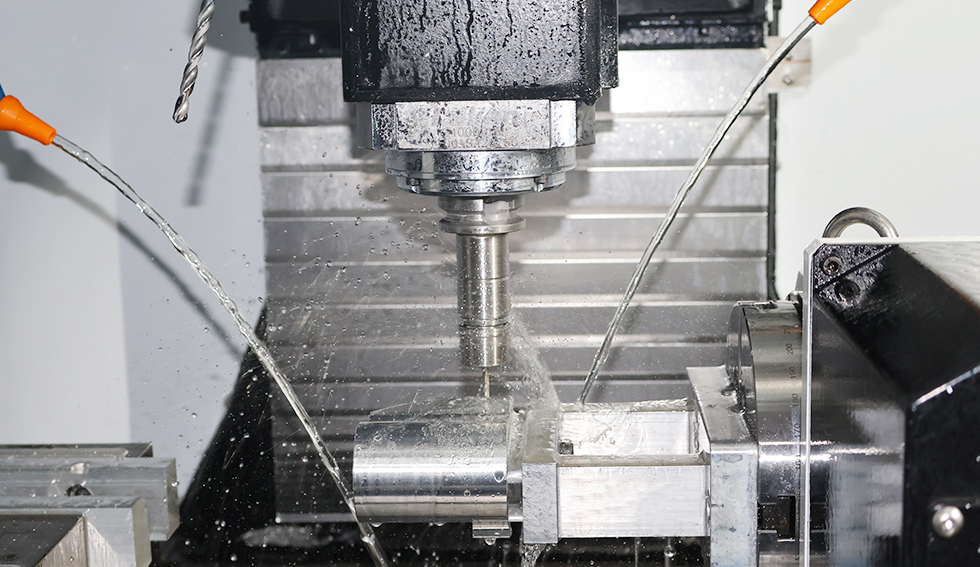
Multi-axis versatility — 3-axis for flat surfaces, slots and 2.5D features at cost-effective pricing; 4-axis adds rotational capability for cylindrical or indexed features; 5-axis offers full 3D freedom for complex contours, undercuts and multi-angle surfaces in one operation.
Surface treatment expertise — anodizing to MIL-A-8625 (Type II decorative, Type III hard coat) for aluminum; passivation or electropolishing for stainless steel.
Design flexibility — thin-walled structures (as thin as 0.5 mm), deep pockets (depth-to-diameter ratio up to 10:1) and intricate lattice structures, with optimized CAM tool paths balancing precision and efficiency.
Material performance — aluminum offers an excellent strength-to-weight ratio for aerospace and automotive; stainless steel excels in high-corrosion environments such as marine equipment and medical device components.
Aerospace — 5-axis milled aluminum wing ribs and stainless steel turbine brackets, anodized for wear protection.
Medical — custom stainless steel surgical instruments and implantable components with electropolished surfaces, and aluminum endoscopic components with anodized finishes (medical-grade finishing available on request).
Industrial automation — high-strength stainless steel gears and aluminum robotic arms, anodized for visibility, used in assembly lines and CNC machinery.
Consumer electronics — thin-walled aluminum casings with anodized color coatings, and stainless steel watch backs with precision-milled engravings.
Q1: What is the difference between your 4-axis and 5-axis services?
A1: 4-axis machining adds a single rotational axis (usually the A-axis), while 5-axis adds two rotational axes (A and B, or A and C), allowing the tool to approach the part from any angle. 5-axis is necessary for complex curves and undercuts; 4-axis is more cost-effective for simpler rotational features.
Q2: How long does the anodizing process take?
A2: Anodizing is typically completed within 24–48 hours after machining, depending on finish type and part size. Rush orders can be expedited on request.
Q3: Can you machine parts with tight internal angles?
A3: Yes — our 5-axis machines use long-reach, small-diameter tools to access tight corners, achieving radii as small as 0.2 mm. For acute angles, wire EDM can be used as a secondary process if needed.
Q4: What is your standard tolerance for 5-axis milling?
A4: ±0.02 mm for most features, with ±0.01 mm available on request for critical dimensions. All tolerances are confirmed in the quoting process based on your design.
Q5: What file formats do you accept?
A5: 2D drawings (CAD, PDF) and 3D models (STEP, X-T, STP). DXF, DWG and IGES are also welcome.
Q6: Do you support both prototypes and mass production?
A6: Yes — we handle everything from single prototypes to production runs, with consistent quality and lead times confirmed per project.


