
Manufacturing mission-critical components presents a compounding difficulty. Titanium’s notorious machinability issues combine with the uncompromising geometric complexity, extreme strength-to-weight ratio, and corrosion resistance required in aerospace, defense, and medical sectors. Utilizing sub-optimal machining processes for titanium introduces severe risks. Excessive tool wear, work hardening, thermal damage, and tolerance stacking from multiple setups directly cause high scrap rates, delayed lead times, and compliance failures. Continuous 5-axis CNC machining stands as the baseline requirement for these applications. This technical evaluation guide provides the framework for selecting a qualified OEM partner capable of delivering repeatable, compliant components through oem 5 axis cnc machining.
Single-Setup Superiority: Continuous 5-axis machining eliminates tolerance stacking and reduces handling time, making it mandatory for complex titanium geometries.
Material-Specific Expertise: Titanium (e.g., Ti-6Al-4V) requires specific machine rigidity, high-pressure coolant systems, and advanced toolpath strategies to prevent work hardening and tool failure.
Strict Compliance Baselines: Viable OEM partners must demonstrate embedded quality control systems, specifically AS9100 for aerospace/defense and ISO 13485 for medical devices, alongside ITAR registration where applicable.
Total Cost of Quality (TCQ): Upfront hourly rates for 5-axis machining are offset by drastic reductions in scrap, secondary operations, and inspection failures.
Continuous 5-axis systems synchronize the three standard linear axes (X, Y, and Z) with two rotary axes (A, B, or C). This synchronization maintains optimal tool-to-part engagement throughout the entire cutting cycle. By tilting the tool or the workpiece dynamically, operators minimize tool stick-out and maximize setup rigidity. Short tool assemblies drastically reduce tool deflection and chatter when cutting tough titanium alloys. This kinematic freedom allows machinists to maintain a constant chip load and optimal cutting speed at the tool tip, ensuring dimensional accuracy across complex, sweeping surfaces.
The mechanical architecture of these machines dictates their performance. Trunnion-style machines cradle the workpiece, providing massive support for heavy titanium billets. Swivel-head machines articulate the spindle itself, accommodating larger, heavier parts that cannot be easily rotated. Both configurations demand high-resolution encoders and zero-backlash drives to translate programmed toolpaths into physical reality without microscopic deviations.
Titanium presents unique physical properties that actively fight the cutting process. It possesses exceptionally low thermal conductivity. Heat generated during the cut does not dissipate into the chip; instead, it concentrates directly on the cutting tool edge and the workpiece surface. Titanium also maintains high strength at elevated temperatures and exhibits a strong tendency to gall, welding itself to the cutting tool.
To mitigate this intense heat build-up, 5-axis machines require high dynamic stiffness and robust vibration damping. Facilities must utilize high-pressure through-spindle coolant systems delivering a minimum of 1,000 PSI directly to the cutting zone. This high-pressure blast fractures the chips, clears the evacuation path, and provides the necessary thermal shock to prevent the tool from melting. Machinists also employ climb milling techniques and trochoidal toolpaths to manage heat generation and control chip thickness.
Machinability Comparison: Titanium vs. Common Alloys |
|||
Material |
Thermal Conductivity (W/m·K) |
Machinability Rating |
Primary Machining Challenge |
|---|---|---|---|
Ti-6Al-4V (Grade 5) |
6.7 |
22% |
Heat concentration at tool edge, galling |
7075-T6 Aluminum |
130 |
100% |
Chip evacuation in deep pockets |
304 Stainless Steel |
16.2 |
45% |
Work hardening during cutting |
Understanding the mechanical difference between continuous simultaneous 5-axis movement and 3+2 (indexed) machining dictates part routing. In 3+2 machining, the rotary axes position the part at a specific angle, lock rigidly into place, and the linear axes perform the cut. This works well for flat features on multiple faces of a prismatic part.
Continuous 5-axis machining moves all five axes simultaneously. The machine controller interpolates the position of the tool tip in real-time as the part rotates and tilts. This continuous motion is non-negotiable for producing the organic shapes, deep cavities, undercuts, and complex aerodynamic curves frequently found in aerospace and medical components. Without simultaneous interpolation, machining a turbine blade or a contoured bone implant would require hundreds of microscopic 3+2 index positions, resulting in unacceptable surface faceting and massive cycle times.
Machining a part in a single clamping operation, known on the shop floor as Done-in-One, offers a massive geometric advantage. It eliminates the cumulative error, known as tolerance stacking, associated with moving titanium cnc parts between multiple machines, vises, and custom fixtures. Every time a machinist unclumps and reclamps a part, microscopic location errors occur.
Single-setup machining guarantees that all geometric features remain perfectly aligned relative to the primary datum. When a bore must be perfectly concentric to an outer diameter located on the opposite side of the part, cutting both features in the same setup is the only way to guarantee a true position tolerance of 0.0005 inches. This approach also slashes work-in-progress (WIP) inventory and reduces the physical handling of expensive raw materials.
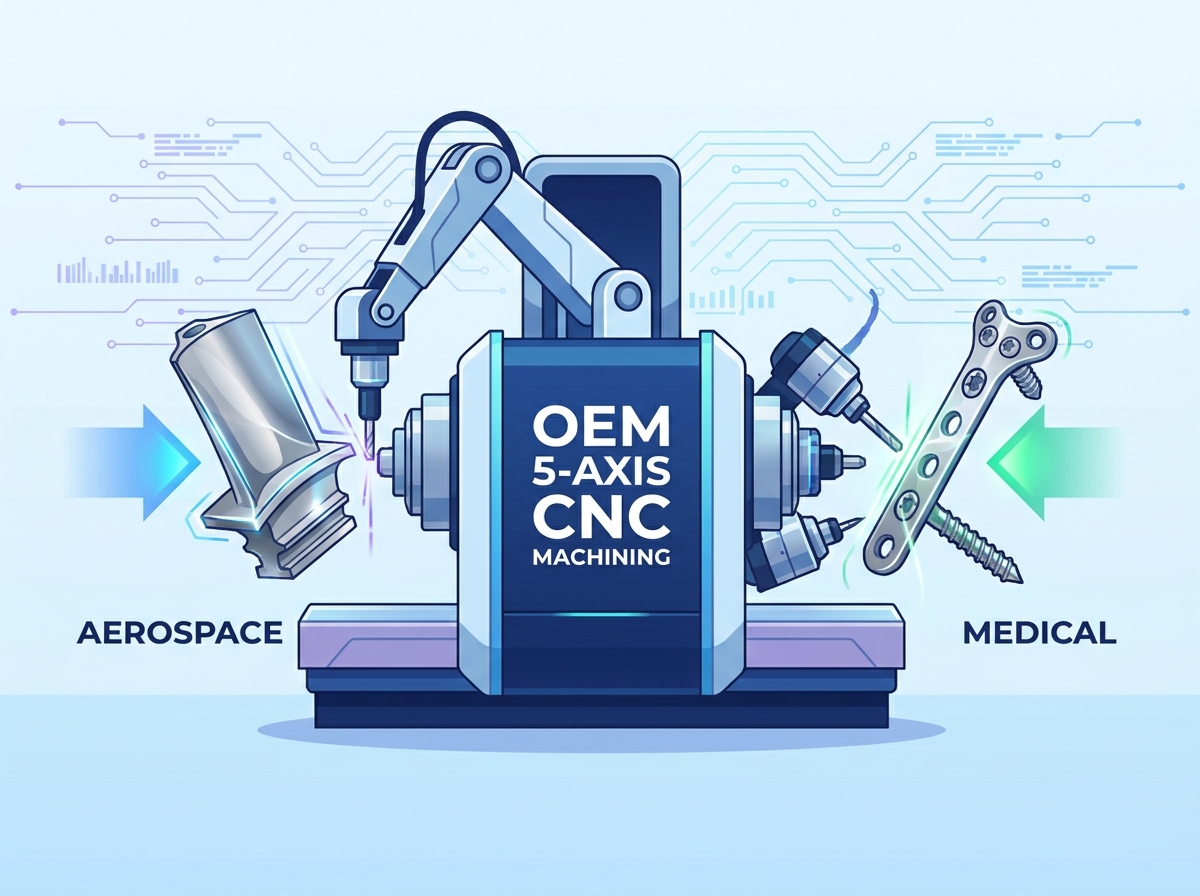
Flight-critical aerospace components demand extreme precision, often requiring tolerances of ±2–5 μm. An OEM must accurately interpret and execute complex Geometric Dimensioning and Tolerancing (GD&T) callouts, such as profile of a surface, true position, cylindricity, and runout. Achieving these tight tolerances in titanium requires rigid machine tools and sophisticated thermal compensation systems.
Machine spindles generate heat during long roughing cycles, causing the machine casting to grow microscopically. Advanced 5-axis centers utilize chilled coolant circulating through the ball screws and spindle jacket to maintain a constant temperature. Furthermore, the machine controller uses thermal sensors to apply real-time offset compensations, preventing dimensional drift during a 14-hour machining cycle on a complex titanium bulkhead.
For aerospace cnc machining, end-to-end lot traceability operates as an absolute necessity. Suppliers must provide original mill material test reports (MTRs) proving the chemical composition and physical properties of the titanium billet. They must also generate comprehensive First Article Inspection (FAI) reports compliant with AS9102 standards, documenting the exact measurement of every single dimension on the blueprint.
Defense-related contracts require ITAR (International Traffic in Arms Regulations) registration. This federal requirement ensures that technical data, CAD models, and manufactured components are securely managed. Facilities must implement strict cybersecurity protocols, physical access controls, and employee verification systems to legally manufacture defense hardware.
Typical components requiring continuous 5-axis machining include turbine blades, structural airframe brackets, landing gear trunnions, and complex engine housings. These parts feature thin walls, deep pockets, and complex aerodynamic profiles that cannot be manufactured using standard 3-axis methods.
Beyond titanium, 5-axis OEM setups must handle other challenging materials. Facilities producing superalloy cnc parts regularly machine Inconel 718, Hastelloy, and Cobalt-Chrome. These nickel-based superalloys exhibit even worse machinability than titanium, causing severe work hardening if the tool rubs instead of cuts. Machinists apply similar rigid setups, ceramic cutting tools, and advanced toolpath strategies to overcome these extreme material properties.
Selecting the correct titanium grade dictates the success of medical applications. Engineers specify Titanium Grade 5 (Ti-6Al-4V) for high-strength structural parts, external fixation devices, and reusable surgical instruments. This alloy provides the necessary tensile strength to withstand heavy mechanical loads.
Conversely, Grade 23 (Ti-6Al-4V ELI - Extra Low Interstitials) and Commercially Pure (CP) Titanium dominate the biomedical implant sector. Grade 23 contains lower levels of oxygen, nitrogen, and iron, resulting in superior ductility and fracture toughness. These grades offer exceptional biocompatibility, allowing human bone to integrate directly with the machined surface without triggering an immune response.
Surface finish dictates the biological performance of medical implants and instruments. Implants often require Ra values down to 0.4 μm or lower to ensure proper osseointegration or to minimize friction in articulating joints like hip replacements. Machinists achieve these finishes using specialized ball nose endmills, high spindle speeds, and microscopic step-overs during the final 5-axis finishing pass.
The medical industry enforces a strict zero-tolerance policy for micro-burrs. A microscopic metal flake detaching from a surgical instrument during an operation causes catastrophic patient complications. Advanced 5-axis toolpaths significantly reduce the need for manual deburring. By programming the machine to chamfer and blend every single edge using a continuous 5-axis motion, OEMs ensure consistent, burr-free edges directly off the machine.
Medical device manufacturing requires strict adherence to ISO 13485 quality management systems. This standard goes beyond basic quality control; it demands comprehensive risk management and process validation. Facilities must execute IQ/OQ/PQ (Installation, Operational, and Performance Qualification) protocols to validate the machining process.
This rigorous validation guarantees part-to-part repeatability. The OEM must prove statistically that their 5-axis machining process will produce a compliant part every single time, regardless of operator changes, tool wear, or environmental fluctuations. This involves extensive capability studies (Cpk) and strict revision control on all CNC programs.
The demand for medical cnc machining covers a wide array of critical components. Common titanium parts include:
Pedicle screws and spinal fusion cages requiring complex thread profiles.
Orthopedic joint replacements featuring highly contoured articulating surfaces.
Dental implants demanding precise micro-machining and specific surface textures.
Maxillofacial trauma plates requiring thin-wall machining without distortion.
Specialized surgical tooling requiring perfect ergonomics and burr-free edges.
When evaluating an OEM's facility, specific hardware specifications indicate true 5-axis capability. Look for direct-drive rotary tables. Unlike traditional worm-gear tables, direct-drive motors eliminate mechanical backlash, allowing for faster, more precise rotary positioning. Linear glass scales on all axes provide absolute position feedback to the controller, bypassing the inaccuracies of ball screw thermal expansion.
High-torque spindles featuring HSK-A63 or HSK-A100 tapers are necessary to maintain stable cutting forces when machining tough titanium alloys. These dual-contact tapers provide massive radial stiffness, preventing the tool from deflecting under heavy cutting loads. This rigidity prevents chatter, extends tool life, and ensures superior surface finishes.
The necessity of digital twin technology and CAM simulation, such as Vericut or NCSIMUL, cannot be overstated. 5-axis kinematics create complex, unpredictable machine motions. A slight programming error can drive the spindle directly into the trunnion table at 1,000 inches per minute.
Simulation software uses the exact G-code and a digital kinematic model of the specific machine tool to verify the program. These tools prevent catastrophic machine collisions, verify gouge-free toolpaths, and optimize tool engagement angles before the operator loads the first titanium blank. By simulating the entire machining process, engineers reduce setup time and eliminate the risk of damaging expensive raw materials.
Robust in-house metrology verifies complex geometries. Standard hand tools cannot measure a sweeping 3D aerodynamic profile. An OEM must possess 5-axis Coordinate Measuring Machines (CMMs) equipped with scanning probes (like the Renishaw REVO system) to accurately measure contoured surfaces by dragging the ruby stylus continuously across the part.
Optical Comparators: Used for verifying complex thread forms and micro-features.
Laser Tool Setters: Measure tool length and diameter dynamically at operating spindle speeds to compensate for thermal growth.
In-Process Spindle Probing: Allows the machine to measure the part while it remains clamped in the fixture, enabling automated offset adjustments before the final finishing pass.
Profilometers: Verify surface roughness (Ra, Rz) to ensure compliance with medical and aerospace finish requirements.
Specialized carbide cutting tools featuring advanced coatings like AlTiN (Aluminum Titanium Nitride) or TiAlN increase upfront tooling costs significantly. A single high-performance 5-axis endmill can cost hundreds of dollars. However, when combined with optimized trochoidal milling paths, these tools drastically reduce overall cycle times.
Trochoidal milling uses a circular tool motion to maintain a constant, low radial depth of cut while utilizing the entire flute length of the tool. This strategy spreads the heat and wear across the entire cutting edge rather than concentrating it at the tip. The initial investment in high-performance tooling pays off by maximizing material removal rates, extending tool life, and reducing the total spindle hours required to produce oem cnc machining components.
The financial viability of 5-axis machining relies heavily on the reduction of scrapped titanium blanks. Aerospace and medical-grade titanium forgings represent a massive upfront material cost. Scrapping a part during the final machining operation destroys thousands of dollars of material and weeks of labor.
Single-setup machining inherently reduces human error. Operators do not need to manually indicate the part multiple times. The elimination of tolerance stacking leads to higher yield rates. By achieving a 99% first-pass yield on complex components, the OEM lowers the total cost of quality and provides more stable pricing to the customer.
A qualified OEM must transition a proven 5-axis program from low-volume prototyping to high-volume, automated production. This scalability requires specific hardware investments. Facilities utilize pallet pools, tombstone fixtures, and robotic loading systems to keep the spindle turning 24/7.
A multi-pallet system allows the operator to load raw titanium blanks onto fixtures outside the machine while the spindle cuts another part inside. Once the cycle finishes, the machine automatically swaps the pallets in seconds. These automation technologies maximize spindle uptime, reduce manual handling, and ensure consistent output for large production runs of 5 axis oem parts.
Procuring aerospace and medical-grade titanium involves significant supply chain volatility. Mill lead times for specific titanium alloys can stretch to 40 weeks during market shortages. Relying on a single material distributor exposes the production schedule to massive delays.
To mitigate this risk, evaluate OEMs with established, diversified material supplier networks. Partners with dual-sourcing capabilities and strategic inventory buffering can navigate material shortages effectively. A robust OEM will stock standard sizes of Ti-6Al-4V billet in-house, ensuring that production schedules remain uninterrupted despite global market fluctuations.
Programming, fixture design, and setup delays pose a significant risk when manufacturing highly complex parts. A poorly designed part can require custom cutting tools with 10-week lead times, stalling the entire project.
To mitigate lead time issues, prioritize OEMs that offer early Design for Manufacturability (DFM) consulting. Engaging in DFM allows the machining experts to suggest minor geometric changes—such as adding standard corner radii or altering a draft angle—that drastically simplify the machining process. This collaboration optimizes tool access, eliminates the need for custom tooling, and allows for faster 5-axis execution, ultimately accelerating the time-to-market.
OEM 5-axis CNC machining requires a higher initial investment, yet it remains the only mathematically and economically viable method for producing compliant, complex titanium and superalloy parts for high-stakes industries. The elimination of tolerance stacking, combined with advanced thermal management and rigorous quality control, guarantees part compliance.
Take the following steps to secure a reliable manufacturing partner:
Audit the supplier’s quality management system to verify active AS9100 or ISO 13485 certifications and ITAR registration.
Request a technical Design for Manufacturability (DFM) review on your most complex CAD model to evaluate their engineering competence.
Verify their in-house metrology capabilities, specifically looking for 5-axis scanning CMMs and documented First Article Inspection procedures.
Submit a purchase order for a small-batch pilot run to validate their actual lead times, surface finish quality, and dimensional accuracy before committing to high-volume production.
A: Top-tier OEMs can hold tolerances between ±2 to ±5 μm depending on the part geometry, thermal controls, and specific titanium alloy used.
A: 5-axis machining allows for single-setup clamping, which eliminates tolerance stacking, reduces handling time, and enables the cutting of complex undercuts and organic shapes like turbine blades without multiple setups.
A: Ti-6Al-4V ELI (Grade 23) is the most common due to its high strength, low weight, excellent fatigue resistance, and superior biocompatibility for implants.
A: It eliminates the need for multiple custom fixtures, reduces operator intervention, drastically lowers the risk of human error, and minimizes scrapped parts.
A: At a minimum, look for ISO 9001. For aerospace and defense, AS9100 and ITAR registration are mandatory. For medical devices, ISO 13485 is required to ensure proper process validation and traceability.
A: Yes, rigid 5-axis machines equipped with high-torque, low-RPM spindles are highly effective for machining other tough superalloys like Inconel, Hastelloy, and Cobalt-Chrome.