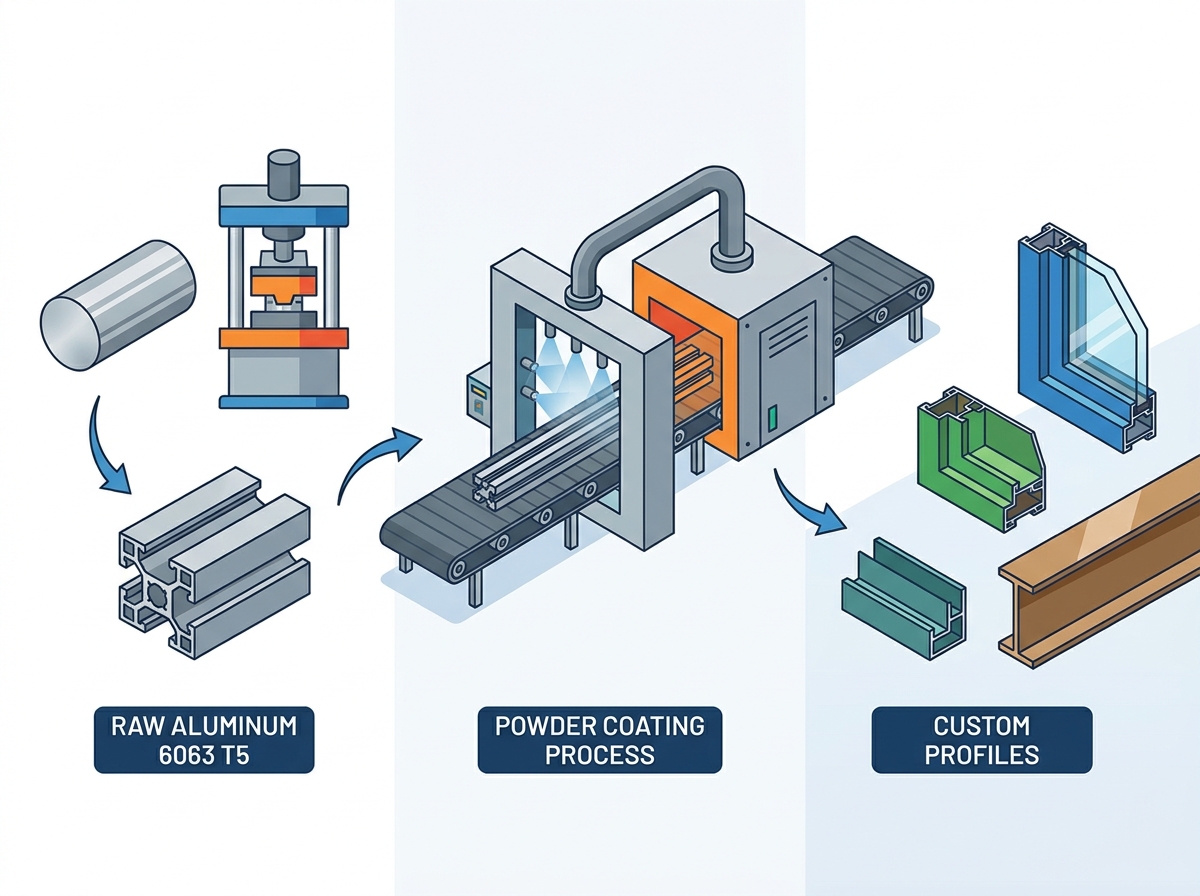
Architectural material selection carries immense stakes. Facade, cladding, and fenestration failures caused by poor material specification often lead to catastrophic replacement costs and compromised building integrity. Architects, design engineers, and procurement teams constantly struggle to balance precise structural tolerances and design flexibility with long-term aesthetic durability when sourcing custom aluminum profiles for large-scale, high-exposure projects. A single failure in the coating adhesion or a slight deviation in the extrusion tolerance can halt a multi-phase construction schedule and trigger massive liability claims.
To mitigate these risks, professionals must adopt a rigorous, evidence-based framework for evaluating custom powder-coated aluminum extrusion profiles. This approach requires a deep understanding of alloy selection, advanced powder-coating processes, adherence to ASTM/AAMA standards, and a thorough assessment of supplier fabrication capabilities. By mastering these elements, project teams can ensure structural stability and lasting visual appeal across decades of environmental exposure.
Alloy Specification is Foundational: Specifying aluminum 6063 t5 provides the optimal balance of extrudability, lightweight strength-to-weight ratio, and surface finish quality for architectural profiles.
Coating Standards Dictate Lifespan: Evaluating powder coated aluminum requires strict adherence to international standards (e.g., AAMA 2603/2604/2605) to prevent premature chalking, fading, and environmental corrosion.
Fabrication Sequencing Matters: Understanding the relationship between extrusion, mechanical fabrication (cutting, punching, machining), and the curing phase of powder coating prevents raw edge exposure and structural failure.
Pre-treatment is Non-Negotiable: The longevity of architectural aluminum profiles relies heavily on multi-stage chemical pre-treatment prior to powder application to ensure permanent chemical adhesion.
The baseline success criteria for aluminum extrusion profiles include structural load-bearing capacity, thermal efficiency, design flexibility, and aesthetic longevity under harsh environmental conditions. Without these characteristics, architectural components fail prematurely. Engineering teams must evaluate how these profiles interact with wind loads, seismic shifts, and extreme temperature fluctuations. The metal must maintain its structural integrity while supporting heavy glazing units and resisting the corrosive effects of urban pollution or coastal salt spray.
A window aluminum profile must meet specific mechanical requirements. These include wind load resistance, secure glazing integration, and compatibility with thermal break assemblies. Modern fenestration systems rely on polyamide thermal struts rolled into the aluminum extrusions to prevent heat transfer. The extrusion tolerances must be exact to ensure these struts fit perfectly without compromising the structural rigidity of the frame.
Uniform surface finishes are equally critical. They ensure visual consistency across massive commercial facades, high-rise window frames, and complex cladding systems. When you look up at a fifty-story high-rise, any variation in the gloss level or color match of the window frames becomes immediately apparent. Achieving this uniformity requires strict control over the extrusion die lines and the subsequent powder coating application parameters.
custom aluminum profiles serve diverse architectural applications. Exterior claddings, visual louvers, interior ceilings, and custom-designed metal furniture all rely on engineered aluminum. Compared to standard structural metals like steel or vinyl, custom extrusions offer superior design flexibility, an exceptional lightweight strength-to-weight ratio, and natural corrosion resistance. You can design a louver system that spans wide gaps without sagging, or a curtain wall mullion that incorporates complex drainage channels directly into the metal shape.
Off-the-shelf profiles often fail to meet unique architectural sightlines, custom glazing pockets, and proprietary thermal barrier systems. Modifying standard extrusions introduces hidden structural and machining costs. You end up milling away material, weakening the profile, and adding unnecessary labor hours to the fabrication floor.
Investing in custom-designed dies eliminates these inefficiencies and ensures exact project specifications are met. A custom die allows the engineer to place the metal exactly where it is needed for structural moment of inertia, while thinning out non-load-bearing walls to save weight. This precise control over the cross-sectional geometry is what makes custom extrusions superior for high-performance building envelopes.
The metallurgical properties of the aluminum 6063 t5 alloy make it the undisputed industry standard for high-performance architectural profiles. This specific alloy blends magnesium and silicon to create a metal that flows smoothly through complex extrusion dies while achieving the necessary mechanical strength after heat treatment.
The T5 temper process involves cooling the metal from an elevated temperature shaping process, followed by artificial aging in an oven. This refines the grain structure and precipitates the alloying elements to maximize strength. Baseline metrics for ultimate tensile strength, yield strength, and elongation limits ensure compliance with international structural building codes. For 6063-T5, you are typically looking at a minimum yield strength of 110 MPa (16,000 psi) and an ultimate tensile strength of 150 MPa (22,000 psi). These numbers dictate how much wind load a mullion can take before it permanently deflects.
The chemical composition of aluminum 6063 t5 allows manufacturers to create complex, thin-walled, multi-cavity custom aluminum profiles. This extrudability does not compromise die life or induce structural defects like tearing or surface blistering. The metal flows evenly, filling the intricate details of screw bosses, weatherstripping grooves, and thermal break pockets.
Furthermore, the alloy develops a natural oxide layer upon exposure to air, providing inherent corrosion resistance even before secondary surface finishing. This natural passivation protects the raw metal during transit and storage before it hits the pretreatment line for powder coating.
Objectively comparing surface finishing technologies justifies the specification of thermoset powder coating for architectural environments. While wet paint and anodizing have their places, powder coating offers a unique combination of durability, environmental compliance, and aesthetic versatility.
Anodizing creates an electrochemical anodic oxide layer by submerging the aluminum in an acid bath and passing an electric current through it. This grows a hard, porous oxide layer that is then sealed. Whereas powder coated aluminum relies on an electrostatic thermoset polymer layer applied over a chemically pretreated surface.
Anodizing has a restricted metallic palette—mostly clear, bronze, and black tones. In contrast, powder coating offers virtually infinite RAL, PANTONE, and custom color-matching capabilities. If an architect specifies a bright terracotta red to match a specific brick facade, powder coating is the only viable option. Additionally, powder coating hides minor extrusion die lines better than anodizing, which tends to highlight any surface imperfections in the raw metal.
The application process for powder coating involves the electrostatic spray deposition of dry powder. The powder particles are charged as they leave the spray gun and are attracted to the grounded aluminum profile. High-temperature heat curing follows, typically around 200°C (392°F), causing the powder to melt, flow, and cross-link into a hard, durable finish.
Powder coatings offer zero VOC emissions, thicker single-coat application, superior edge-coverage, and enhanced scratch resistance compared to liquid PVDF paints. Liquid paints require solvents to keep the resin fluid, which evaporate and create environmental hazards. Powder coating overspray can also be reclaimed and reused, making it a highly efficient material process.
Procurement, quality assurance, and engineering sign-offs require a strict checklist of technical specifications. You cannot simply order "white aluminum profiles" and expect them to survive on a coastal high-rise. You must specify the exact tolerances, coating thicknesses, and performance standards.
Acceptable tolerance standards, such as EN 755-9 or equivalent ASTM standards, dictate limits for wall thickness, straightness, twist, and angularity in architectural aluminum profiles. Poor die maintenance, incorrect extrusion speeds, or uneven cooling severely impact structural assembly fitment in curtain wall and window systems.
If a mullion has a slight twist, the glass units will not sit flat against the gaskets, leading to air and water infiltration. If the wall thickness is extruded too thin to save metal, the screws holding the assembly together will strip out under wind load. Specifying and verifying these tolerances during the First Article Inspection (FAI) is mandatory.
Required dry film thickness, measured in microns, varies between standard architectural applications and aggressive marine or industrial environments. Evaluating AAMA specifications provides a reliable framework for performance expectations.
AAMA Standard | Application Environment | Weathering Performance | Typical Resin Type |
|---|---|---|---|
AAMA 2603 | Light commercial, residential interiors, mild climates | 1 year South Florida exposure | Standard Polyester |
AAMA 2604 | High-traffic commercial exteriors, storefronts | 5 years South Florida exposure | Super Durable Polyester |
AAMA 2605 | High-performance architectural, monumental high-rises | 10 years South Florida exposure | Fluoropolymer (FEVE) |
Testing for adhesion involves the cross-hatch tape test, where a grid is cut into the coating and aggressive tape is applied and ripped off. If any squares of coating detach, the pretreatment or curing process failed.
Verifying custom colors requires a systematic workflow using international standard reference systems like RAL and PANTONE, alongside custom wet-sample submittals. Addressing the physical risks of metamerism—where colors shift under varying light sources—and batch-to-batch color variation is critical for large-scale multi-phase construction developments.
A building facade installed over two years will require multiple extrusion and coating runs. If the powder manufacturer does not tightly control the pigment formulation, the panels installed in year two will look noticeably different from those installed in year one. Always require spectrophotometer readings and visual checks under standardized D65 daylight bulbs.
Identifying where the custom manufacturing process typically fails allows procurement teams to effectively audit supplier workflows. The most beautiful extrusion design will fail in the field if the factory floor lacks rigorous process controls.
Automated pre-treatment is the primary determining factor in preventing filiform corrosion. This process typically involves multi-stage acid or alkaline cleaning followed by advanced chrome-free conversion coatings (such as zirconium or titanium-based baths). Proper pre-treatment etches the aluminum surface on a microscopic level and deposits a chemical conversion layer that bonds aggressively with the powder coating resin.
If the wash tanks are contaminated or the rinse water has high dissolved solids, the powder will bridge over the impurities. Within a few years, moisture will penetrate the coating, react with the raw aluminum, and cause the paint to blister and flake off in large sheets.
The manufacturing sequence presents distinct technical trade-offs that impact both longevity and logistics.
Extrude -> Powder Coat -> Fabricate (Cut/Punch/Drill): This sequence saves handling time and allows for bulk coating of long linear lengths. However, it exposes raw aluminum edges to atmospheric moisture wherever a cut or hole is made, significantly increasing edge-corrosion risks.
Extrude -> Fabricate -> Powder Coat: This method ensures 100% surface and edge encapsulation. Every punched hole and mitered cut gets coated. However, it requires strict dimensional coordination and custom hanging fixtures during the coating process to handle smaller, fabricated parts.
Common finish failures include orange peel, pinholes, chalking, blistering, and poor adhesion. These defects trace back to specific manufacturing failures. Pinholes often result from moisture in the compressed air lines feeding the powder guns. Orange peel happens when the powder is applied too thick or the curing oven ramps up temperature too slowly, preventing the powder from flowing out smoothly. Chalking is a sign of UV degradation, indicating that an AAMA 2603 powder was mistakenly used in an AAMA 2604 or 2605 application.
Procurement timelines require careful evaluation. Key stages include custom extrusion die design and machining, first-article inspection (FAI) approval, bulk extrusion runs, surface finishing, and transit protection packaging. Cutting corners on the FAI phase to save a week on the schedule often results in receiving thousands of meters of unusable material that fails structural assembly on the job site.
Financial evaluation must extend beyond the raw per-kilogram metal cost to capture true project value. Focusing solely on the lowest bid per ton ignores the massive downstream costs of poor quality.
The upfront investment of custom extrusion dies offsets long-term material expenses. Custom dies eliminate multi-part mechanical assemblies and significantly reduce machining waste. Instead of buying three standard shapes and screwing them together, you invest in one custom die that extrudes the complex shape in a single pass. The die pays for itself within the first bulk production run through reduced assembly labor and fewer fasteners.
Calculating the return on investment involves factoring in the elimination of field maintenance, long-term UV resistance, extended manufacturer warranties, and the avoidance of premature facade remediation. Specifying an AAMA 2605 coating adds upfront cost to the powder material, but it guarantees the building will not require a multi-million dollar scaffolding and repainting project ten years after completion.
Successful procurement of custom powder-coated aluminum extrusion profiles demands equal focus on metallurgical precision, exact fabrication sequencing, and strict adherence to high-performance AAMA coating standards. Buyers should filter manufacturers based on verified in-house pre-treatment lines, modern automated powder lines, transparent QA/QC documentation, and accredited third-party testing.
Initiate a formal engineering review of all custom die profiles to optimize wall thickness and thermal break integration before cutting steel.
Request physical first-article samples for color validation under standardized lighting and verify dimensional tolerances with calipers.
Audit the supplier's chemical pretreatment line logs to ensure consistent bath concentrations and proper rinse water quality.
Specify the exact AAMA performance tier (2603, 2604, or 2605) directly on the purchase orders and architectural drawings.
Secure a copy of the supplier's Quality Management System (QMS) certifications and require cross-hatch adhesion test reports for every batch.
A: The standard range is typically 60 to 80 microns. However, marine or highly industrial environments often demand thicker coatings or multi-coat primer-and-topcoat systems for adequate protection against aggressive salt and chemical exposure.
A: It provides an ideal balance of surface finish quality, excellent extrudability for complex thermal break cavities, superior corrosion resistance, and sufficient mechanical properties to meet structural wind-load demands without cracking during extrusion.
A: The RAL system is typically used for industrial and architectural coatings, providing standardized physical color chips. PANTONE is often used in graphics and design. Manufacturers convert these color codes into specific custom powder formulations using spectrophotometers.
A: Pre-fabrication before coating offers maximum protection against corrosion at raw edges, encapsulating the entire part. Post-fabrication is highly cost-effective for long linear runs but requires careful edge sealing during installation to prevent moisture ingress.
A: Realistic lifespans depend heavily on the specific AAMA standards applied. AAMA 2603 lasts a few years outdoors, AAMA 2604 provides 5 years of robust weathering, and AAMA 2605 delivers 10 to 20 years of superior color and gloss retention.