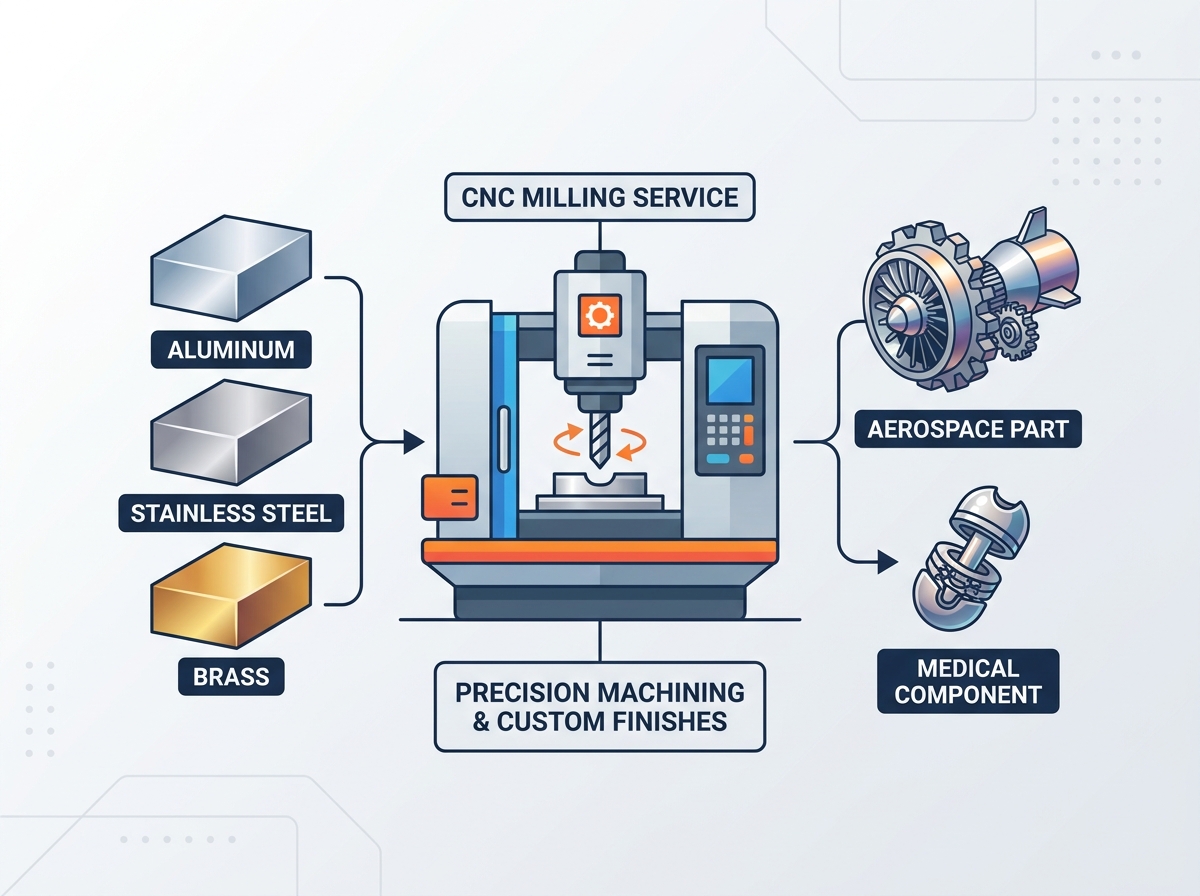
Sourcing precision custom parts is a high-stakes procurement decision. Tolerance failures, poor surface finishes, or delayed lead times can derail entire production schedules and inflate project budgets. Engineers and procurement teams must balance speed, precision, and cost across varying material properties while navigating a fragmented market of automated digital networks and traditional machine shops. Selecting the right cnc milling service requires moving beyond automated quoting platforms to rigorously evaluate a vendor's technical capabilities, material-specific expertise, and compliance frameworks. You need a partner capable of translating complex CAD geometries into physical reality without compromising structural integrity. This means scrutinizing their equipment list, understanding their approach to workholding, and verifying their inspection protocols. A successful partnership hinges on transparent communication regarding design for manufacturability (DFM) and a shared commitment to quality control from the initial prototype through low-volume production runs.
Tightening tolerances creates an exponential cost curve. Standard tolerances of ±0.005 inches are cost-effective and widely achievable across most commercial equipment. Pushing boundaries to ±0.0008 inches or tighter demands specialized equipment, frequent tool changes, and climate-controlled environments to mitigate thermal expansion. Over-tolerancing increases cycle times, limits tool selection, and drives up scrap rates. You must balance functional necessity with manufacturing reality. Specifying a ±0.0005 inch tolerance on a non-mating surface forces the machinist to slow down feed rates and perform multiple spring passes, adding unnecessary machine hours to the job.
| Tolerance Tier | Typical Range | Cost Impact | Best Application |
|---|---|---|---|
| Standard | ±0.005" to ±0.010" | Baseline | Non-mating surfaces, brackets, enclosures |
| Precision | ±0.001" to ±0.002" | Moderate Increase | Slip fits, locating pins, standard bearing bores |
| High-Precision | ±0.0005" to ±0.0008" | High Premium | Press fits, aerospace components, medical implants |
Unit economics shift dramatically from single-unit prototyping to mid-volume production runs of 100 to 1,000 units. Setup times, custom fixturing, and CAD/CAM programming costs heavily impact the price of low volumes. As quantities increase, these fixed costs amortize across the batch, reducing the per-unit price significantly. When evaluating a shop, look at their approach to workholding. Shops utilizing zero-point clamping systems or custom tombstone fixtures can transition from one job to the next rapidly, which lowers the setup burden passed on to you.
As-machined finishes, measured in Ra values, often suffice for internal components. A standard 125 Ra finish is typical for roughing, while 63 Ra or 32 Ra requires finishing passes with sharp tools. Secondary operations alter final part functionality and dimensional tolerances. You must account for material removal or addition during finishing stages to ensure parts remain within spec.
Rapid-turn manufacturing can deliver prototypes in a few days, but this speed carries a premium cost and may limit complex quality assurance checks. Standard production lead times of 10 to 15 business days offer better cost efficiency and allow for comprehensive inspection protocols, ensuring higher consistency across larger batches. Expedited services often mean interrupting existing production schedules, which is why the expedite fee exists. Plan your procurement cycles to utilize standard lead times whenever possible to maintain budget control.
Common alloys like 6061-T6, 7075-T6, and 5052 offer high machinability, excellent weight-to-strength ratios, and strong thermal conductivity. 6061 is the industry workhorse, while 7075 provides superior strength for aerospace applications. Producing high-quality anodized aluminum cnc parts requires careful surface preparation, such as acid etching or matte blasting. You must also manage edge breaking and account for dimensional growth post-anodization. Poorly machined surfaces with heavy tool marks will show through the anodized layer, making the initial machining strategy critical for cosmetic parts.
Machining 304, 316, and 17-4 PH stainless steel presents distinct challenges. Work hardening and tool deflection necessitate rigid machine setups and high-pressure coolant delivery. 304 is notorious for work hardening if the tool rubs instead of cutting. While stainless steel offers superior mechanical properties and corrosion resistance, it increases cycle times, reduces cutting speeds, and elevates tooling costs. Machinists must use carbide tooling with specific coatings like TiAlN to withstand the heat generated during the cutting process.
Brass alloys like C360 and C3604 are free-machining materials ideal for high-speed production, intricate geometries, and tight tolerances. The addition of lead in C360 acts as an internal lubricant, allowing chips to break cleanly. Sourcing small brass parts involves micro-milling challenges, requiring high-RPM spindles, micro-tooling wear management, and specialized workholding. Brass excels in fluid power, electrical connectors, and low-friction applications, offering low tool wear and excellent surface finishes without heavy post-processing.
Determining when part geometry requires 5 axis cnc machining depends on complexity. Complex organic shapes, deep cavities, and multi-sided machining without repositioning justify the investment. Standard 3-axis or 3+2 indexable machining remains more cost-effective for simpler parts. Reduced setups in 5-axis machining mitigate tolerance stack-up and improve overall part accuracy. Every time a part is manually flipped and re-indicated in a vise, a small margin of error is introduced. 5-axis equipment eliminates these manual interventions.
Partnering with a vendor offering both milling and cnc turning is necessary for parts requiring prismatic and cylindrical features, such as shafts with milled flats or cross-holes. Consolidating multi-process parts with a single vendor reduces lead times, simplifies logistics, and ensures consistent quality control. Mill-turn centers or Swiss lathes with live tooling can complete these complex parts in a single operation, drastically reducing cycle times and handling errors.
Wire EDM serves as a critical companion to traditional milling. Deploy Wire EDM for conductive metals to achieve sharp internal corners, extremely deep slots, and delicate geometries prone to deflection under conventional milling cutters. When a design calls for a zero-radius internal corner in hardened tool steel, standard end mills cannot physically produce that geometry. Wire EDM cuts using electrical discharges, exerting zero physical force on the workpiece, making it ideal for fragile components.
Producing aerospace cnc parts requires mandatory quality management systems like AS9100 Rev D. Full material traceability, mill source validation, lot tracking, and non-destructive testing are critical to ensure structural integrity and regulatory compliance. You cannot simply buy aluminum from an unknown supplier; every piece of raw stock must have an accompanying Material Test Report (MTR) tracing it back to the original mill melt. First Article Inspection (FAI) reports, specifically AS9102 formats, are standard requirements before full production begins.
Evaluating medical cnc parts focuses on ISO 13485 compliance, cleaning protocols, and cleanroom packaging. Machining medical-grade materials like titanium, PEEK, and surgical stainless steel involves strict requirements for burr-free, easily sterilizable surface finishes. Any microscopic burr left on an implantable device can harbor bacteria or detach inside the patient. Machinists must utilize specialized deburring tools under magnification and employ ultrasonic cleaning lines to remove all traces of cutting fluids.
Automated online quoting engines offer speed but have limitations. Basic algorithm-driven DFM checks flag obvious tool access issues or non-standard tapped holes. Deep-dive engineering reviews identify critical risks like deep-hole tap breakage, thin-wall vibrations, or internal corner radius constraints. An algorithm might approve a deep pocket, but a human machinist knows that reaching the bottom with a long-reach end mill will cause chatter, resulting in a poor surface finish and out-of-tolerance dimensions.
Evaluate how digital manufacturing networks manage machine capacity, raw material sourcing, and localized versus offshore production routes. Reliable vendors guarantee delivery dates through robust supply chain redundancy. Ask potential partners about their machine uptime, maintenance schedules, and backup material suppliers. A shop running at 100% capacity has no room to absorb a machine crash or a delayed material shipment, which means your parts will be late.
Identify obscured costs in quotes, including non-recurring engineering (NRE) fees, custom fixturing charges, programming fees, surface treatment setup costs, and minimum order quantities (MOQs). A low per-unit price might be offset by a massive upfront NRE charge for custom tombstone fixtures. Always request itemized quotes to understand exactly what you are paying for and whether those tooling costs are a one-time fee or applied to every order.
Vendors may use off-spec or uncertified raw materials to cut costs. This is especially dangerous in aerospace and medical applications where material failure leads to catastrophic results. Mitigate this risk by mandating material test reports (MTRs) and certificates of conformance (CoC) prior to production release. Conduct periodic audits of your supplier's material intake process.
Tool wear, thermal expansion, and machine vibrations during long production runs cause parts to fall out of spec. A tool that cuts perfectly on part number one might be worn down by part number fifty, leaving a larger dimension. Require First Article Inspection (FAI) reports and inquire about the vendor's in-process probing systems and coordinate measuring machine (CMM) inspection frequencies. Spindle probes can automatically check critical dimensions during the machining cycle and adjust tool offsets to compensate for wear.
A: Standard tolerances typically range around ±0.005 inches. Tighter tolerances like ±0.001 inches or better are achievable but require specialized equipment, controlled environments, and slower feed rates, which increase manufacturing costs and cycle times.
A: Choose 5-axis machining for complex organic shapes, deep cavities, or parts requiring machining on multiple sides. It eliminates manual repositioning, reduces setup errors, and prevents tolerance stack-up across complex geometries.
A: CNC turning rotates the workpiece against a stationary cutting tool to create cylindrical parts like shafts and pins. CNC milling rotates the cutting tool against a stationary workpiece to create prismatic shapes, slots, and flat surfaces.
A: Acid etching or matte bead blasting provides an optimal, uniform surface preparation before anodizing. This removes light tool marks and ensures consistent color absorption and finish quality across the entire part.
A: Aerospace components strictly require AS9100 Rev D certification. Manufacturers must also provide comprehensive material traceability, mill test reports, and AS9102 First Article Inspection reporting to ensure regulatory compliance.
A: Softer materials like aluminum machine faster and reduce tool wear, lowering costs. Harder materials like stainless steel or titanium require slower cutting speeds, rigid setups, and frequent carbide tool replacements, increasing overall expenses.
A: Use Wire EDM for cutting intricate details, sharp zero-radius internal corners, or very deep slots in hard, conductive metals where standard end mills would deflect, chatter, or physically break during the cutting process.