
Ever wondered how manufacturers create precise parts so quickly? CNC milling is the key. This process powers much of modern manufacturing, making it crucial for both beginners and professionals to understand.
In this article, we'll break down how CNC milling works, explore its types, and look at its applications across industries. By the end, you'll have a clear understanding of its importance in today's world of manufacturing.
CNC milling is a computer-controlled subtractive manufacturing process. It uses digital designs to guide cutting tools in removing material from a workpiece, such as metal, plastic, or wood, to create precise shapes and parts.
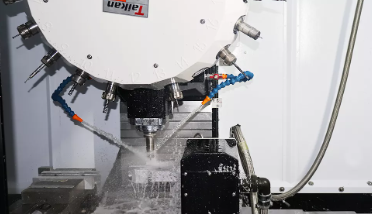
Unlike traditional milling, which requires manual operation of the machine, CNC milling is fully automated. In traditional milling, the operator controls the machine’s movements by hand, while CNC milling machines are guided by computer software. This leads to higher precision and faster production times with less human error.
CNC milling is driven by the CNC (Computer Numerical Control) system. The process begins when a digital design is created using CAD (Computer-Aided Design) software. This design is then converted into machine-readable instructions through CAM (Computer-Aided Manufacturing) software, which generates the necessary tool paths and cutting parameters.
The CNC machine follows these instructions step by step, precisely moving the cutting tools to remove material from the workpiece. The machine can work along multiple axes, such as the X, Y, and Z axes, to shape the part in three-dimensional space.
CNC milling allows for high precision and complex shapes, reducing material waste and speeding up production. It also ensures that parts are made with consistent quality every time.
Before a part can be made, a CAD (Computer-Aided Design) model needs to be created. CAD software is a tool that designers and engineers use to build precise digital models of parts or components. These models include detailed specifications, dimensions, and other important features, providing a virtual representation of the final product. Popular CAD software programs include AutoCAD, SolidWorks, and Fusion 360.
Once the CAD model is ready, it needs to be converted into instructions that the CNC machine can understand. This is done using CAM (Computer-Aided Manufacturing) software. CAM software takes the CAD model and generates the tool paths, cutting speeds, and other machining parameters necessary for the CNC machine to create the part.
These instructions are typically written in G-code and M-code:
G-code: Directs the machine’s movement, telling it where to move, how fast, and when to cut.
M-code: Controls machine functions, such as turning the spindle on and off, or activating coolant.
After the code is generated, the CNC machine needs to be set up. This includes loading the correct tools into the spindle and securing the workpiece onto the machine table. The machine is calibrated to ensure proper alignment and accuracy. This setup is crucial, as even small errors can result in defects or a failed part.
Once the machine is set up, the CNC milling program is executed. The CNC machine begins following the instructions step by step, moving along the X, Y, and Z axes (and sometimes additional axes) to precisely cut and shape the workpiece. The cutting tools remove material from the workpiece to create the desired shape, with the machine constantly checking and adjusting the process to maintain accuracy.
After the milling is complete, the part may need some final finishing. This can include deburring (removing sharp edges), polishing, and applying surface treatments for a smoother finish. Additionally, a thorough quality control check is performed to ensure the part meets all required specifications. This step helps identify any imperfections or errors before the part is considered ready for use.
CNC milling machines come in various types, each designed for specific tasks and operations. The choice of machine depends on factors like part complexity, precision, and production speed. Below, we’ll explore the most common types of CNC milling machines.
Key Features:
Spindle is positioned vertically above the workpiece.
Ideal for operations where the cutting tool needs to move vertically down to the workpiece.
Uses and Advantages:
Best for smaller, less complex parts.
Commonly used for drilling, tapping, and facing operations.
Simple setup and easy maintenance.
Versatile and cost-effective for various industries, including automotive and aerospace.
Vertical mills are highly effective for tasks requiring quick setups and precision on relatively simple parts.
Key Features:
Spindle is oriented horizontally, allowing the cutting tool to move across the workpiece.
Typically equipped with a rotary table for multi-surface machining.
Uses and Advantages:
Ideal for larger, heavier workpieces.
Excellent for making deep cuts and cutting multiple surfaces at once.
Commonly used in high-volume production and for tasks like cutting grooves or slots.
Offers faster chip removal due to gravity aiding the process, which reduces heat buildup.
Horizontal mills are perfect for large-scale projects, where precision and efficiency are crucial.
Importance of 4-Axis and 5-Axis Machines in Complex Operations:
4-axis machines add the ability to rotate the workpiece around one axis, providing more freedom to cut complex geometries.
5-axis machines offer even more flexibility, allowing the cutting tool to move along five axes simultaneously. This is essential for producing intricate shapes and curved surfaces with extreme accuracy.
How Multi-Axis Machines Improve Precision and Reduce Production Time:
Multi-axis machines eliminate the need to reposition the part multiple times, which improves consistency and reduces human error.
These machines can create highly complex shapes in one setup, saving time and increasing efficiency in manufacturing.
Multi-axis CNC machines are invaluable for industries like aerospace, automotive, and medical devices, where precision and complexity are key.
Overview of Specialized Types:
Type of CNC Machine | Description |
CNC Machining Centers | Combine the capabilities of both CNC mills and lathes, offering greater flexibility in a single setup. |
Planer Milling Machines | Used for heavy-duty tasks, offering high precision and the ability to work with large, flat surfaces. |
Gantry Mills | Have a large framework allowing movement across multiple axes, typically used for large parts or heavy-duty operations. |
Specialized milling machines cater to unique production needs, offering versatility and efficiency for complex or large-scale manufacturing operations.
Advantages of Subtractive Manufacturing (CNC Milling) vs Additive Manufacturing (3D Printing):
CNC milling is a subtractive process, meaning it removes material from a larger block to shape the final part. This allows for high precision and a smooth finish right from the start. On the other hand, 3D printing is an additive process, which builds parts layer by layer from materials like plastic or metal. While 3D printing is excellent for creating complex geometries and prototypes, CNC milling often provides superior strength, finish, and precision.
When to Use CNC Milling vs 3D Printing:
Use CNC Milling when you need high precision, durability, and a clean surface finish. It’s great for materials like metals, plastics, and composites that need to withstand stress or high temperatures.
Use 3D Printing for prototyping, custom parts with complex shapes, or when speed and cost are crucial factors. It’s ideal for creating parts that would be difficult to machine using traditional methods.
Comparing CNC Milling with CNC Turning (Lathe) and Their Respective Uses:
Both CNC milling and CNC turning (lathe) are highly accurate machining methods, but they are used for different tasks. CNC milling is ideal for creating flat, complex shapes, holes, and slots, while CNC turning (lathe) is used to shape cylindrical parts by rotating the workpiece against a cutting tool.
Key Differences in the Type of Cuts and Materials Suited for Each Process:
CNC Milling: Great for cutting 3D shapes, flat surfaces, and precision details in materials like metals, plastics, and composites.
CNC Turning: Best for producing round or cylindrical parts, such as shafts, bushings, and bolts. It’s ideal for materials that require precise rotational cuts.
While CNC milling can handle a variety of shapes and sizes, CNC turning excels in high-precision parts that need to be turned, offering a smooth finish for round components.
Q: What is the difference between CNC milling and CNC turning?
A: CNC milling uses rotating cutting tools to remove material from a workpiece, while CNC turning rotates the workpiece against a stationary cutting tool to shape cylindrical parts. Milling is ideal for complex, flat surfaces; turning is used for round parts.
Q: How precise are CNC milling machines?
A: CNC milling machines are highly precise, capable of achieving tight tolerances, often within 0.001 inches (0.025 mm). Their precision makes them suitable for applications requiring exact measurements and smooth finishes.
Q: Can CNC milling be used for mass production?
A: Yes, CNC milling can be used for mass production, especially for parts requiring high precision and consistency. It is efficient for both low and high-volume production runs.
Q: What industries use CNC milling the most?
A: CNC milling is widely used in industries such as aerospace, automotive, medical devices, electronics, and metal fabrication due to its precision and ability to handle complex parts.
Q: How long does it take to set up a CNC milling machine for a new project?
A: Setup time for CNC milling machines can vary but typically takes a few hours. This includes loading tools, securing the workpiece, and calibrating the machine for the specific task.
CNC milling is a precise, computer-controlled manufacturing process that removes material from a workpiece using CAD and CAM software. It plays a crucial role in producing complex, high-quality parts across industries like aerospace, automotive, and medical. Its efficiency, versatility, and ability to create accurate parts make CNC milling an essential technology in modern manufacturing.