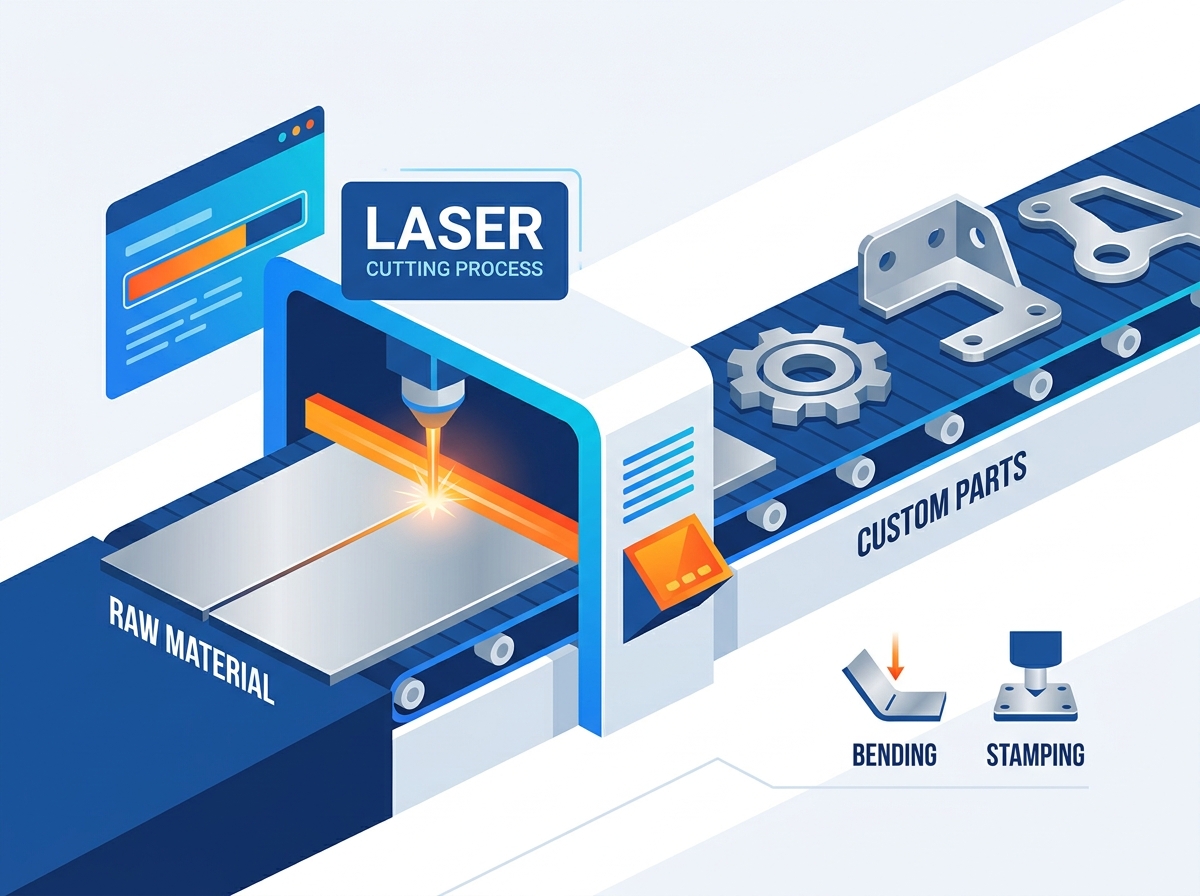
Fabricating high-performance components from tough, reflective alloys requires exactness. sheet metal laser cutting provides the tight tolerances needed for modern engineering. Stainless steel demands specialized thermal processing to prevent warping, edge oxidation, and metallurgical degradation. Using the correct cutting technology directly impacts component accuracy, production lead times, and overall project success.
You need a reliable method to produce complex geometries without compromising structural integrity. Traditional mechanical cutting often leaves burrs, induces material stress, and requires extensive secondary finishing. Laser technology solves these issues by melting and blowing away material with pinpoint accuracy. We will explore how to optimize your flat patterns, select the right material grades, and evaluate fabrication partners for your next production run. You will learn the mechanics of fiber laser technology, material specifications for different steel grades, and essential design guidelines to keep your manufacturing floor running smoothly.
Fiber lasers generate a highly focused beam using optical fibers doped with rare-earth elements like erbium or ytterbium. This active gain medium amplifies light, delivering high-density energy directly to the cutting head through a flexible transport fiber. The resulting beam has a very small focal diameter, often around 50 to 100 microns. This intense concentration of energy easily penetrates reflective alloys like stainless steel, which traditionally bounce back light from older laser types. The technology converts electrical power into laser light with remarkable wall-plug efficiency, often exceeding 30 percent. This translates to faster cutting speeds, lower power consumption, and cleaner edges on flat sheet materials. Operators can adjust the focal position dynamically, allowing the machine to pierce thick plates and then rapidly accelerate across thin sections without stopping to change lenses.
Historically, CO2 lasers dominated the fabrication industry, relying on a gas mixture to generate the beam and complex mirror systems to deliver it. Today, fiber lasers offer superior processing speeds on thin-to-medium gauge sheet metal. The shorter wavelength of a fiber laser (typically 1.06 micrometers) absorbs much better into metallic surfaces compared to the 10.6-micrometer wavelength of a CO2 laser. CO2 lasers struggle with reflective materials because the beam often bounces back, risking severe damage to the machine optics and requiring constant realignment.
Fiber lasers cut thin stainless steel up to three times faster than CO2 counterparts, drastically reducing machine cycle times.
Nitrogen assist gas is used with fiber lasers to blow away molten metal at high pressures (often exceeding 250 PSI). This produces a clean, oxide-free edge ready for welding.
Oxygen assist gas is sometimes used for thicker plates to create an exothermic reaction, speeding up the cut but leaving an oxidized edge that requires mechanical removal.
Fiber systems require significantly less maintenance due to the absence of moving mirrors, bellows, and laser gases.
The solid-state nature of fiber lasers means no beam path purging is necessary, eliminating a common source of contamination and downtime.
Cutting stainless steel presents unique thermal challenges on the shop floor. Dross formation occurs when molten metal solidifies on the bottom edge of the cut before it can be blown clear. Proper focal position, correct nozzle selection, and adequate assist gas pressure eliminate this issue. Another challenge is the Heat-Affected Zone (HAZ). Excessive heat alters the metallurgical properties of the steel, precipitating chromium carbides and reducing localized corrosion resistance. Fiber lasers minimize the HAZ by moving rapidly across the material and utilizing a highly concentrated energy profile. This rapid processing maintains the structural integrity and aesthetic finish of the raw sheet. Operators must also monitor thermal distortion, especially when cutting dense nests of small parts on thin-gauge sheets. Strategic cutting sequences, such as cutting internal features before the outer perimeter and skipping around the sheet to distribute heat, prevent the material from bowing and crashing the cutting head.
The success of your project depends heavily on material selection. Different environments require specific alloy compositions, and choosing the wrong grade leads to premature field failure.
Grade 304: This is the industry workhorse. It offers excellent corrosion resistance and formability due to its 18 percent chromium and 8 percent nickel composition. You will find it in kitchen equipment, architectural paneling, and general-purpose enclosures.
Grade 316: This grade contains molybdenum, which provides superior marine-grade corrosion resistance against chlorides. It is ideal for harsh environments, chemical processing equipment, and coastal applications where 304 would pit and rust.
Grade 430: A ferritic stainless steel with lower corrosion resistance and no nickel content. It is magnetic, less expensive, and often used for indoor decorative trim or appliance housings where severe moisture is not a factor.
Grade 17-4 PH: A precipitation-hardening martensitic stainless steel used when high strength and moderate corrosion resistance are required. It is frequently utilized in aerospace and structural components.
Modern laser systems handle a massive range of material thicknesses. High-wattage fiber lasers (ranging from 4kW up to 20kW and beyond) easily process ultra-thin foils down to 0.030 inches. These thin materials require rapid travel speeds and precise height control to prevent warping and nozzle collisions. On the other end of the spectrum, heavy structural plates up to 0.500 inches and beyond are cut with precision. Thicker plates require slower speeds, larger nozzle diameters, and higher gas pressures to clear the kerf effectively. When cutting thick stainless steel with nitrogen, the gas consumption increases exponentially, making process optimization critical for maintaining profitability.
Engineers rely on laser cutting for its exceptional repeatability. Typical dimensional tolerances for laser-cut sheet metal parts range from +/- 0.005 inches to +/- 0.010 inches, depending on the machine's condition and the material thickness. Material thickness directly influences achievable edge taper. Thicker plates naturally exhibit a slight taper as the beam diverges through the material, usually around 1 degree. Thin sheets maintain near-perfect vertical edges. Consistent material quality, flat sheets free of internal stresses, and properly calibrated machines ensure dimensional repeatability across large production runs. Thermal drift in the machine frame and variations in ambient shop temperature can also affect tight tolerances, which is why high-end machines utilize linear drives and active chiller systems.
Waterjet cutting uses a high-pressure stream of water (up to 90,000 PSI) mixed with abrasive garnet. It is a cold-cutting process. This means there is absolutely no Heat-Affected Zone, no thermal distortion, and no change to the material's temper. Waterjet is required when thermal distortion is unacceptable or when cutting extremely thick materials that exceed laser capabilities. However, laser cutting offers significantly higher processing speeds for thin-to-medium gauge metals. Lasers also provide a smoother edge finish on stainless steel, require less messy cleanup, and are generally more cost-efficient for high-volume production. Waterjet cutting often leaves a frosted edge finish and requires parts to be dried immediately to prevent water spots.
Plasma cutting forces ionized gas through a constricted nozzle, creating an electrical arc that melts the metal. It is incredibly fast for severing heavy structural steel and is highly effective on dirty or rusted materials. However, plasma struggles with dimensional accuracy and surface roughness. The kerf is much wider (often exceeding 0.100 inches), and the edge taper is pronounced. Plasma is reserved for ultra-thick plates where loose tolerances are acceptable and secondary machining will clean up the critical dimensions. Laser cutting provides superior precision, a much narrower kerf, and minimal dross, making it the better choice for intricate geometries and tight-tolerance components.
Choosing the right method depends on your specific project requirements. Review the comparison below to understand the trade-offs between precision, speed, and thermal impact.
Process | Best For | Typical Precision | Speed (Thin Metal) | Heat-Affected Zone | Edge Quality |
|---|---|---|---|---|---|
Fiber Laser | Thin to medium stainless steel, intricate profiles | High (+/- 0.005") | Very Fast | Minimal | Excellent, smooth |
Waterjet | Thick plates, heat-sensitive parts, mixed materials | High (+/- 0.005") | Slow | None | Good, frosted appearance |
Plasma | Ultra-thick structural plates, heavy fabrication | Low (+/- 0.030") | Fast | Large | Rough, requires grinding |
Efficient material usage drives down production costs. Nesting software arranges flat patterns on a raw sheet to maximize yield. Proper CAD layouts ensure high sheet utilization, often pushing above 80 percent. Designers should share common cut lines between parts where possible, a technique known as common-line cutting, which saves both material and machine time. Leaving adequate spacing between nested parts (typically equal to the material thickness) prevents thermal distortion and web blowout. Smart nesting strategies significantly reduce scrap rates and lower the per-part cost for custom sheet metal projects. Operators must also consider grain direction when nesting parts that will be formed later, as bending parallel to the grain increases the risk of cracking.
Designing for the laser process requires specific geometric considerations. Following these rules ensures clean cuts, prevents manufacturing delays, and reduces the need for manual rework.
Minimum Hole Diameters: Hole sizes should typically equal or exceed the material thickness. Piercing holes smaller than the material thickness causes blowout, irregular shapes, and excessive heat buildup. If a smaller hole is required, the laser can etch a center mark for secondary drilling.
Tab Sizes and Micro-Joints: Small parts can fall through the cutting bed slats, causing machine crashes or lost components. Design micro-joints (small un-cut tabs usually 0.010 to 0.020 inches wide) to keep small parts secured to the main sheet during the cutting process. These are easily snapped out manually later.
Accounting for Kerf: The laser beam removes a small amount of material, known as the kerf. This is typically 0.005 to 0.015 inches depending on the focal length and material thickness. CAD files should be drawn to nominal dimensions, allowing the CAM software to apply kerf compensation automatically.
Corner Radii: Sharp internal corners create stress concentrations and force the machine to decelerate to a complete stop. Adding a small radius (even 0.010 inches) to internal corners improves part strength and allows the laser head to transition smoothly, maintaining cutting speed.
Bridge Widths: The minimum distance between two cutouts (the bridge) should be at least the thickness of the material. Narrower bridges will melt away or warp due to the concentrated heat of the laser beam.
Smart design eliminates the need for secondary operations. Avoid placing features too close to the edge of the part, which can cause material warping and weak structural points. Specify high-pressure nitrogen assist gas for stainless steel cutting to prevent oxidized edges. This eliminates the need for mechanical edge cleaning or chemical descaling before welding or painting. Designing self-locating tabs and slots simplifies downstream assembly and welding processes, acting as built-in fixturing that reduces setup time on the welding bench.
Flat laser-cut profiles often require forming into three-dimensional shapes. Integrating precision laser cutting with press brake forming creates complex enclosures, chassis, and brackets. Bending metal parts requires careful calculation of bend allowances, bend deductions, and K-factors. The laser cuts the flat blank to the exact developed length based on these calculations. The press brake then applies tonnage through a punch and V-die to fold the material along precise bend lines. Consistent material thickness, accurate laser cutting, and proper grain direction orientation are critical for accurate bending. Air bending is the most common method, where the punch presses the material into the die without bottoming out, allowing for flexibility in bend angles by adjusting the ram depth.
Choosing between laser cutting and stamping depends entirely on production volume, part complexity, and upfront budget constraints.
Use flexible laser cutting for low-to-medium volumes and prototype iterations. It requires zero tooling investment, allows for rapid design changes, and gets parts in your hands in days rather than weeks.
Transition to progressive die stamping parts for high-volume production. Stamping requires expensive hard tooling upfront (often tens of thousands of dollars) but delivers extremely low piece-part costs at scale, producing hundreds of parts per minute.
Laser cutting is ideal for heavy gauge materials that exceed the tonnage capacity of standard stamping presses or for geometries too complex for a die to punch cleanly.
Hybrid approaches exist where a laser cuts the complex outer profile, and a press brake or simple hard tool forms the internal features.
Raw laser-cut edges are generally clean, but some applications require further refinement. Deburring and edge rounding remove micro-sharpness and dross for safety and aesthetic appeal. This is especially important for parts handled by end-users or components that will route wiring. Passivation and pickling are chemical treatments used to restore the chromium oxide protective layer. The heat from the laser can slightly deplete this layer at the cut edge, leaving it susceptible to rust. Proper passivation using nitric or citric acid baths ensures the stainless steel retains its maximum corrosion resistance in the field. Additionally, orbital sanding or graining can be applied to match the surface finish of the raw sheet, hiding any handling marks from the fabrication process.
Time to market is critical in modern manufacturing. Traditional manual RFQs take days to process, requiring estimators to manually calculate cut lengths and material yields. Today, instant pricing engines analyze CAD geometry, identify features, and provide immediate feedback. A modern laser cutting service uses these tools to streamline the quoting process. This allows engineers to iterate designs rapidly and understand cost drivers in real time. Look for partners who accept native CAD formats (like STEP or IGES) alongside flat DXF files, and who provide a transparent breakdown of material costs, machine time, and secondary operations.
Your fabrication partner must adapt to your project lifecycle. Evaluate prototype-friendly suppliers with no minimum order quantity (MOQ). This allows you to test form, fit, and function without committing to large batches or holding unnecessary inventory. As your product gains market traction, ensure the supplier can scale. They should have the machine capacity, redundant laser systems, and floor space to handle high-volume production and OEM contract manufacturing without compromising lead times. A shop with only one laser is a bottleneck waiting to happen if that machine goes down for maintenance.
Balancing speed with quality requires robust logistics. Rapid-turnaround capabilities of 2 to 4 days are essential for agile development and keeping assembly lines moving. However, speed must not compromise part protection. Stainless steel surfaces are highly prone to scratching during transit. Reliable freight management and specialized packaging are mandatory. Suppliers must use protective films (often left on during the laser cutting process), custom pallets, foam interleaving, and secure strapping to ensure aesthetic parts arrive in pristine condition. Parts dumped loosely into a box will arrive damaged and unusable.
Precision manufacturing demands rigorous quality oversight. Source from shops with established quality management systems. ISO 9001 certifications demonstrate a commitment to consistent process control, document traceability, and continuous improvement. Strict first-article inspection (FAI) protocols ensure the initial parts meet all print specifications before full production begins. Ask potential suppliers about their inspection equipment. They should utilize automated optical comparators, coordinate measuring machines (CMM), and calibrated hand tools to verify dimensions, hole locations, and bend angles accurately.
Successfully executing a custom stainless steel project requires careful planning, accurate CAD data, and the right fabrication partner. By understanding laser mechanics and material properties, you can optimize your designs for manufacturability and eliminate unnecessary costs. Take the following steps to move your project forward:
Export your final 3D models into flat-pattern DXF or STEP files, ensuring all bend deductions are calculated correctly for the specific material thickness.
Verify that your hole diameters, bridge widths, and bend radii meet the minimum geometric requirements to prevent blowout and tooling issues.
Request a small prototype run to validate the edge finish, dimensional accuracy, and fitment before committing to a full production batch.
Confirm that your chosen supplier offers the necessary secondary operations, such as press brake forming, hardware insertion, and passivation, under one roof to reduce logistical delays.
A: High-power fiber lasers (10kW and above) can cut stainless steel up to 1.25 inches thick. However, the most efficient processing, tightest tolerances, and cleanest edges are typically achieved on thicknesses between 0.030 inches and 0.500 inches.
A: Nitrogen acts as an inert shielding gas during the cutting process. It blows away molten material at high pressure without reacting chemically with the metal. This prevents oxidation and leaves a clean, weld-ready edge.
A: Yes, excessive heat can cause thin sheets to warp, especially when cutting dense nests of small parts. Fiber lasers minimize this risk by cutting rapidly. Proper part nesting and strategic cut sequencing also help dissipate heat.
A: Not always. Many modern laser systems can cut directly through specialized laser-safe protective films. This film protects the aesthetic finish of the stainless steel during cutting, bending, and subsequent handling.
A: Provide clean 2D vector files like DXF or DWG for flat parts. Ensure all contours are closed, remove overlapping lines, and scale the drawing 1:1. For formed parts, provide a 3D STEP file so the fabricator can calculate bend allowances.